Hail Damage Repair Cost 2026: Why Premiums Fell Anyway
Hail repair runs $250 to $8,000 a car. In the year to July 2026, repair prices rose 6.6% and car insurance fell 4.5%. The squeeze lands on your total-loss line.
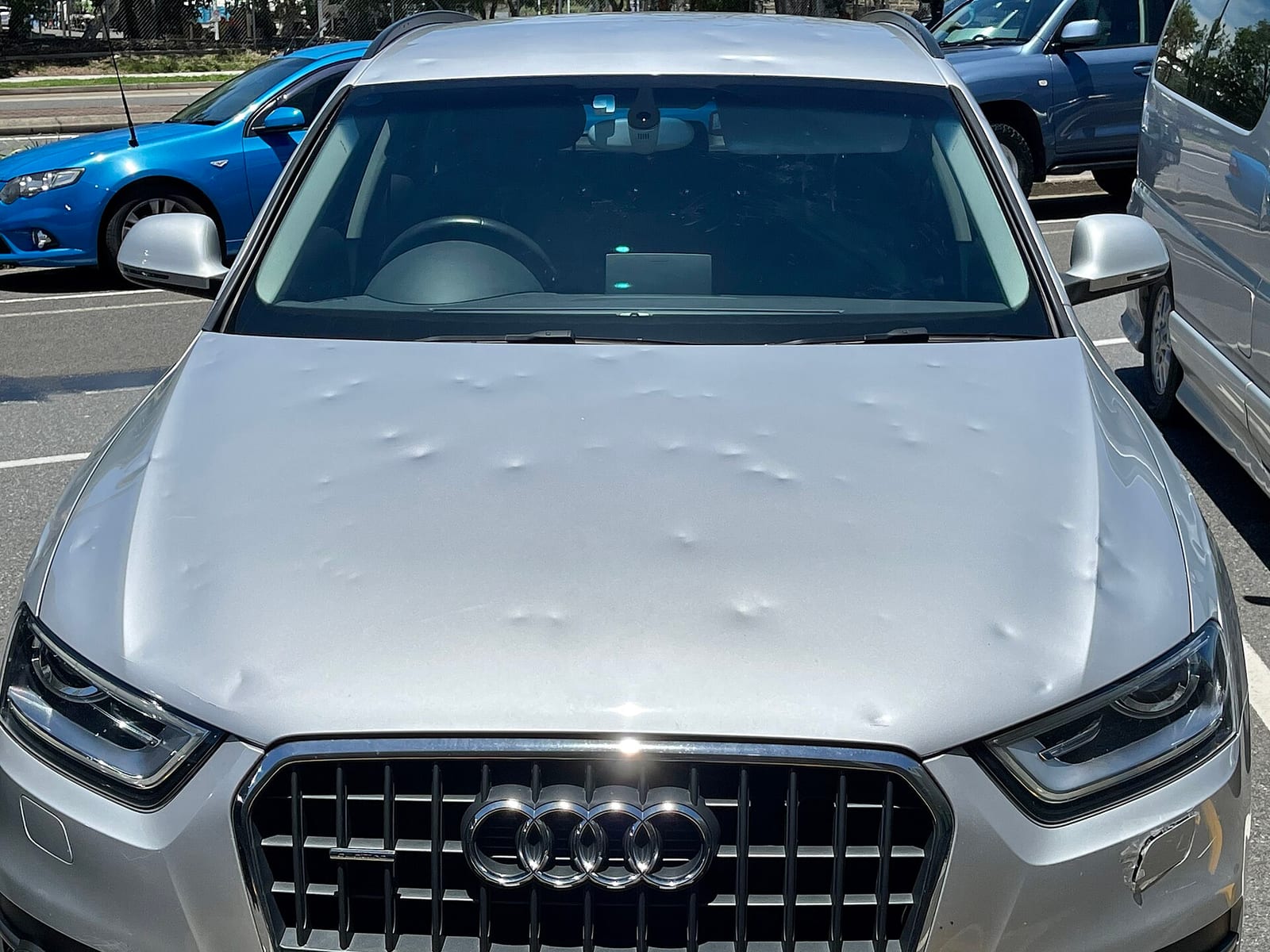
Hail damage repair runs $250 to $8,000 for a whole car in 2026, or roughly $150 to $1,500 per dented panel. Most of that is labor, not parts, which is why the bill keeps climbing even though car insurance premiums have actually fallen this year.
That last part surprises people, and it is the reason this page exists. Search for hail repair costs right now and you will find a wall of articles explaining that tariffs are inflating your premium. The government’s own price data says the opposite is happening. Premiums are down. Repair is up sharply. Both are true at once, and the gap between them is where hail claims get decided.
What does hail damage actually cost right now?
Hail is priced per panel, not per dent, because a tech works a panel at a time. Light, scattered dimpling runs about $150 to $400 a panel. Moderate density lands at $350 to $800. Severe runs $700 to $1,500. A car that took it across the hood, roof, trunk and both sides is eight panels, which is how a single storm turns into a $2,000 to $4,000 job on an ordinary sedan and pushes past $8,000 on a newer one. The hail damage cost estimator multiplies severity by panel count if you want your own number.
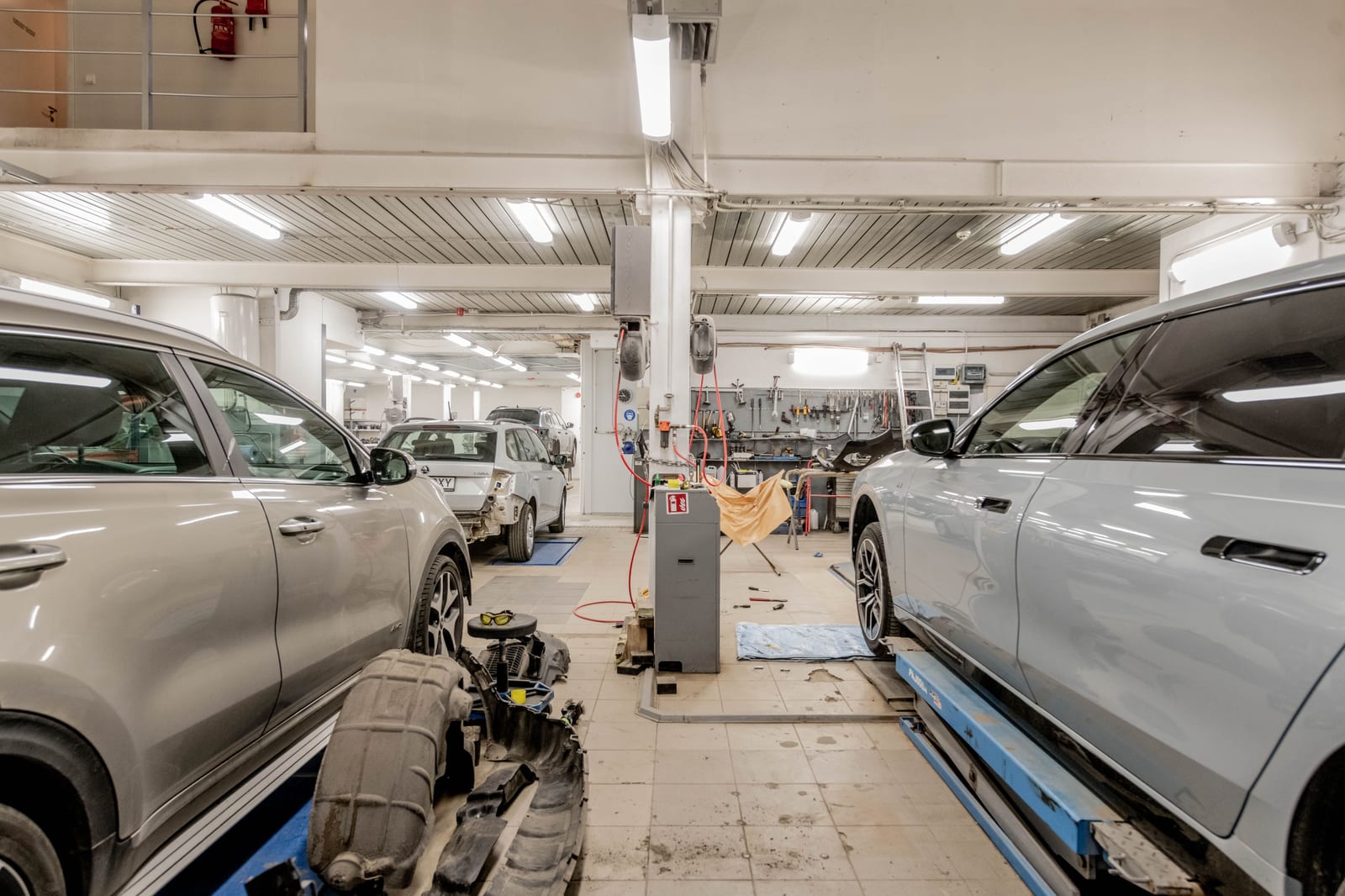
The important structural fact: on a paintless job there is almost no parts content. A tech with rods, glue tabs and a light board is selling hours. That makes hail repair unusually exposed to labor inflation and unusually insulated from anything happening at a port, which turns out to matter a great deal in 2026.
Why did repair prices rise 17.9% in two years while premiums fell?
Two federal price series tell the story, and they point in opposite directions.
Motor vehicle repair, the Bureau of Labor Statistics series that tracks what shops charge, sat at 262.764 in July 2024 and 309.733 in July 2026. That is a 17.87 percent rise in two years. The broader maintenance and repair series rose 6.62 percent in the last twelve months alone.
Motor vehicle insurance went the other way. It peaked in February 2026 and has fallen since, ending July 2026 at 856.080 against 896.018 a year earlier. That is a 4.46 percent decline year over year.
Why the two diverge is not something these tables can settle, and anyone who tells you otherwise is guessing in public. What they do settle is direction. Insurance has fallen in every single month since that February peak. Repair sits higher in July 2026 than in any month before it.
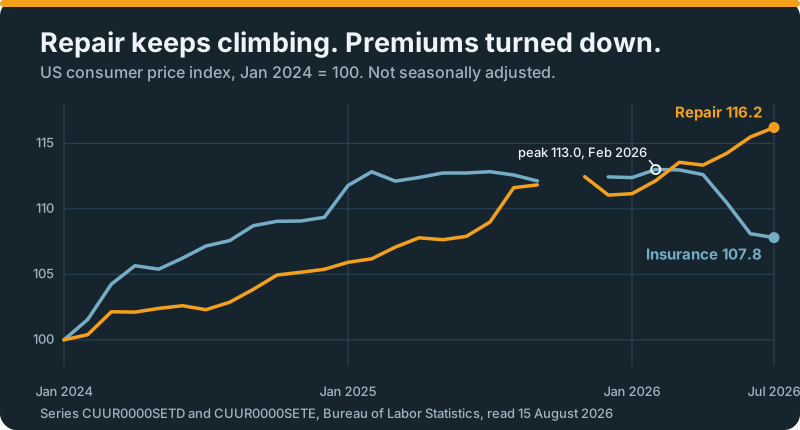
So the pressure is real, but it does not arrive on your premium line. It arrives on the estimate, which means it arrives at the moment an adjuster decides whether your car is worth fixing.
Weren’t the tariffs struck down in February?
Partly. This is where most of what you will read is now out of date, and the distinction is worth getting right because it changes what you should expect on a parts bill.
On 20 February 2026 the Supreme Court decided Learning Resources, Inc. v. Trump, holding that the International Emergency Economic Powers Act “does not authorize the President to impose tariffs.” Collection of the IEEPA duties was terminated the same day by executive order. A temporary 10 percent balance-of-payments surcharge ran from 24 February to 24 July 2026 under a different statute and has now expired on its own terms.
None of that touched the auto tariffs. Section 232 rests on a different statute with different language, and the opinion draws that contrast itself: “IEEPA does not contain such sweeping, discretion-conferring language.” Proclamation 10908 put a 25 percent tariff on imported automobiles from 3 April 2025 and on imported auto parts from 3 May 2025, and it is still in force. The current tariff schedule, 2026 Revision 16, still lists auto parts under heading 9903.94.05 at the applicable duty plus 25 percent.
If you replace a part on your car, that is the tariff you are paying. Here is what it lands on, by category:
| Cosmetic part | Tariff heading | Base duty | Plus Section 232 |
|---|---|---|---|
| Bumpers | 8708.10.30 | 2.5% | 25% |
| Parts of bumpers | 8708.10.60 | 2.5% | 25% |
| Body panels and other body parts | 8708.29.51 | 2.5% | 25% |
| Bodies and cabs | 8707.10.00 | 2.5% | 25% |
| Road wheels | 8708.70.45 | 2.5% | 25% |
| Windshields, laminated | 7007.21.11 | 4.9% | 25% |
| Rear-view mirrors | 7009.10.00 | 3.9% | 25% |
| Lighting equipment | 8512.20.20 | Free | 25% |
| Visual signaling equipment | 8512.20.40 | 2.5% | 25% |
Rates from the USITC tariff schedule, 2026 Revision 16, read 15 August 2026. Vehicles and parts from the UK, Japan, the European Union, South Korea and Taiwan sit at negotiated rates of 7.5 to 15 percent instead of 25.
Notice what is missing from that table. There is no line for a dent. Tariffs are a tax on things that cross a border, and the fix for paint-intact hail damage is a person with a rod, standing in your state.
One caveat about those two percentages, because it changes what they prove. The repair series is a services index, built from what shops charge on real repair orders, so whatever the shop paid for parts is already inside it. It is not a clean labor rate, and no federal index breaks out collision parts on their own. So 17.87 against 4.37 is not a measurement of labor beating parts in a fair fight. What holds without an index to referee it is the structure of the job: a paintless hail repair buys hours and almost no parts, which leaves a tariff on imported components very little to tax. Blaming a hail bill on a port gets the mechanism backwards.
What about bumper repair cost?
This is where a tariff has something to tax, and it is worth separating from hail for exactly that reason. A bumper cover is not massaged back into shape, it is replaced. Bumper repair cost runs about $300 to $1,500 depending on whether the cover is scuffed, cracked or carrying sensors behind it, and unlike a dent, a large share of that is an imported part sitting at 2.5 percent base duty plus 25 percent. Same for a wheel, a mirror, a headlight assembly. That claim rests on the duty schedule above rather than on any price series: nothing published separates bumper covers from the rest of motor vehicle parts, and the 4.37 percent figure covers them along with everything else in the category.
The rule of thumb that follows: the more your repair is a part, the more tariffs matter; the more it is an hour, the more labor inflation matters. A bumper scuff and a hail-dimpled hood are moving on two different escalators. If a shop quotes you a hail job and cites tariffs, ask which part they are importing.

What does two years of repair inflation do to one claim?
Take one job and hold everything constant except prices. A five-year-old compact sedan carrying high miles, severe hail, eight dented panels, a cracked windshield and a blown-out rear window. Same damage, same car at the same age, priced in July 2024 and again in July 2026.
Each line moves by its own published index. The labor lines follow motor vehicle repair, up 17.87 percent across the two years. The parts lines follow motor vehicle parts and equipment, up 4.37 percent. The car itself follows used cars and trucks, up 2.83 percent.
| Line item | July 2024 | July 2026 | Escalator |
|---|---|---|---|
| Paintless dent repair, 8 panels at $700 | $5,600 | $6,601 | repair, +17.87% |
| Glass fitting labor | $280 | $330 | repair, +17.87% |
| Windshield | $420 | $438 | parts, +4.37% |
| Rear window glass | $310 | $324 | parts, +4.37% |
| Mouldings and clips | $180 | $188 | parts, +4.37% |
| Repair total | $6,790 | $7,881 | |
| Vehicle actual cash value | $9,300 | $9,563 | used vehicles, +2.83% |
| Repair as share of value | 73.0% | 82.4% |
Read the July 2024 column as a constructed baseline, not a quote off a real estimate. Eight panels at $700 each is the bottom of the severe band above. The glass, moulding and fitting figures are ordinary mid-range aftermarket numbers, picked once and then held still so that only prices move. The $9,300 value is a round figure for a five-year-old compact with high mileage, and it clears the $9,000 line Minnesota uses to define a high-value vehicle. Only the escalators are sourced: BLS series CUUR0000SETD03, CUUR0000SETC and CUUR0000SETA02, July 2024 against July 2026.
After that it is multiplication. The eight panels, $5,600 at 1.1787, become $6,601, and glass fitting labor goes $280 to $330. On the parts side 1.0437 turns $420 into $438, $310 into $324, $180 into $188. The column adds to $7,881 against $6,790. The car, $9,300 at 1.0283, becomes $9,563. Divide each total by its own year’s value: 73.0 percent, then 82.4 percent.
The damage did not change. The car did not change. The repair-to-value ratio moved 9.4 percentage points, because repair prices climbed more than six times faster than used vehicle values. That is the whole mechanism, and it is why the total-loss line is where 2026 actually shows up.
When does an insurer total a hail car?
When repair cost gets close enough to the car’s value that fixing it stops making sense. Each state sets that line differently, and most of them set it in the vehicle-title statute rather than leaving it to the insurer.
One term has to come first, because four of these five statutes are gated on it. A late model vehicle is a statutory category, not a sales term, and a car that falls outside it is not covered by the percentage rule at all. Each state draws that age line in its own place, in the third column below. The five-year-old sedan is inside all of them, in both years, which is the only reason this comparison is legitimate.
| State | Statutory threshold | Applies to this car? | 2024 claim at 73.0% | 2026 claim at 82.4% | Hail treated separately? |
|---|---|---|---|---|---|
| Iowa | 70% of fair market value | Yes. No age or value gate, only a $500 value floor | Total | Total | No carve-out in the statute |
| Kansas | 75% of fair market value | Yes. Late model, meaning the model year of the damage year or the six before it | Repairable | Total | Yes, cosmetic windstorm or hail damage is excluded |
| Nebraska | 75% of retail value | Yes. Late model on the same six-year test, or retail value over roughly $12,500 | Repairable | Total | No carve-out in the statute |
| Missouri | 80% of fair market value | Yes. Damaged no more than six years after its model year | Repairable | Total | Yes, repair total excludes damage from hail |
| Minnesota | Repair cost exceeds the vehicle’s value | Yes. Late model at five years, and above the $9,000 high-value line | Repairable | Repairable | No carve-out in the statute |
Three states flip from repairable to total on price movement alone: Kansas, Nebraska and Missouri. That is the practical cost of two years of repair inflation, and no premium notice will ever mention it.
Now the part almost nobody writes down. Two of those five states pull hail out of the percentage calculation. Kansas brands a late model car as salvage at 75 percent of fair market value, but only where the damage was:
“not merely exterior cosmetic damage to such vehicle as a result of windstorm or hail.”
Missouri sets its line at 80 percent, then removes hail from the number you compare against it:
“The total cost of repairs to rebuild or reconstruct the vehicle shall not include the cost of repairing, replacing, or reinstalling inflatable safety restraints, tires, sound systems, or damage as a result of hail …”
Missouri goes further and defines a hail-damaged vehicle as its own category in statute, separate from a salvage vehicle.
Read that carefully, because the limit on it matters as much as the carve-out does. These statutes govern the title brand, not the insurer’s economic decision, and the carve-out reaches only one part of the title test: the percentage. Kansas takes hail out of the number you compare against 75 percent. Missouri takes it out of the number you compare against 80 percent. Neither one closes the other door.
That door is the insurer. Kansas brands any vehicle “that the insurer determines is a total loss and for which the insurer takes title,” a separate subsection the hail language never reaches. Missouri makes a vehicle salvage once it “has been declared salvage by an insurance company as a result of settlement of a claim.” Iowa is blunter still: a vehicle whose ownership transfers to an insurer as a result of a settlement “shall be deemed to be a wrecked or salvage vehicle.” So a hail-only car can come out of a Kansas, Missouri or Iowa settlement carrying a salvage brand, carve-out or no carve-out, if the insurer wrote a check for the car and kept it.
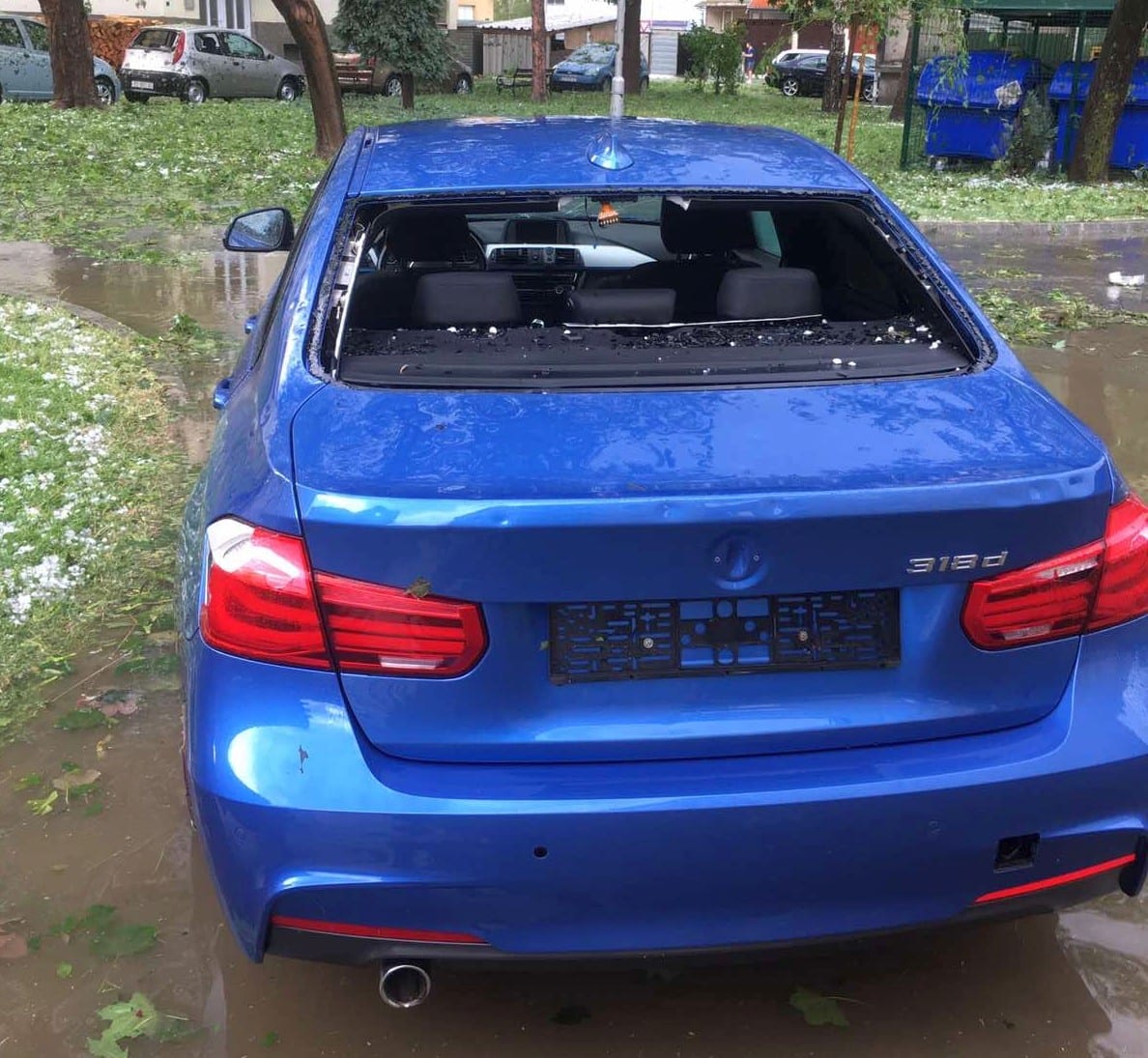
What the carve-out does buy you is narrower and still worth having: on the percentage test, cosmetic hail should not be the thing that pushes a title over the line. If a hail-only claim comes back branded and the insurer did not take the car, that is the moment to ask which line items went into the repair total.
Minnesota is the other useful outlier. Its statute triggers the salvage brand when repair cost “exceeds the value of the damaged vehicle,” effectively 100 percent, with a separate 80 percent rule that applies only to a self-insured owner. Widely republished lists give Minnesota a flat 80 percent. The statute does not.
If the estimate clears your deductible by a comfortable margin, hail is usually a straightforward claim to file. The threshold question only becomes live where the car’s value has already come down and the hit was severe, and that is exactly the car whose ratio moved most since 2024.
When is the damage small enough to fix yourself?
Rarely, and the honest test is narrow. A DIY pull is worth trying on a shallow, rounded dent in the flat middle of a panel, with the paint fully intact and access from behind. That is one or two dings after a light storm, not a pelted roof. Anything on a body line, anything creased, anything with a chipped edge, and any panel carrying dozens of dents belongs with a tech, because the failure mode of a bad pull is a stretched panel that now needs the repaint you were avoiding. Run a fingernail across it first: catch a crack or bare metal and paintless work is already off the table, as covered in paintless repair versus a body shop.
Sort your own damage before spending anything:
| What you have | DIY viable? | What a bad attempt costs you |
|---|---|---|
| Shallow round ding, flat panel, paint intact, access behind | Yes | Little. Worst case it stays as it is |
| Shallow ding, no access behind the panel | Glue pull only | A pulled paint chip, turning a $150 job into a repaint |
| Dent on a body line or crease | No | Stretched metal, and the crease sets permanently |
| Any chipped, cracked or bare-metal edge | No | Rust starts under the lifted edge |
| Dozens of dents across a panel | No | Uneven high spots that a tech then charges more to undo |
If your damage genuinely is one or two clean dings, three tools cover it:
As an Amazon Associate, PanelProof earns from qualifying purchases.
- Paintless dent repair rod and tap-down kit for working a dent from behind the panel, where you have access through a door frame or trunk opening. The catch is that rods reward practice and punish impatience. Expect a first attempt to look worse before it looks better, so make that attempt on a panel you can live with. Check current price.
- Glue-pull kit with a line board for dents you cannot reach from behind. The reflector board is the part that matters, since you cannot fix a dent you cannot see the edges of. What glue pulling cannot do is fine work: it lifts the middle and tends to leave a ring around the pull, and on paint that is already chipped it takes more of the paint with it. Check current price.
- Suction cup puller for a shallow dish with good access, and nothing sharper than that. Check current price.
Set the expectation properly: a careful amateur gets a shallow ding from obvious to barely visible. Nobody gets a hail-covered hood right on a weekend. If you are weighing the work against a sale, the resale math is in fixing cosmetic damage before selling, and single-dent pricing sits in the car dent repair cost guide.
What to do with all this
Get the panel count and the severity, turn that into a range before you call anyone, and then find out your car’s actual cash value, because in 2026 that second number decides more than it used to. A $7,900 estimate is a routine repair on a $25,000 car and a total-loss call on a $9,600 one, and the line between them moved more than nine points in twenty-four months while nobody sent a notice about it.